The Space You Don't Fill: Japanese Lessons in Leaving Room at the Edges

Photo: Japanese minimalist room empty shelf wall edge soft daylight, via phoenixmassagevancouver.com
There is a particular kind of exhaustion that comes from trying to use every square foot. The shelf that must be full. The calendar that must be optimized. The conversation that must be steered toward a point. In Japan, empty space is not automatically a failure. It has names. Not because Japanese cities are less crowded, but because crowding makes edges valuable. A margin can be a place to pause. A gap can let air and light through. A blank shelf can let a room breathe.
This is not a decorating manual. It is a set of words you can borrow. Each one points to a small, observable scene from everyday Japan, and each one offers permission to leave something unfilled.
1. Ma: The Interval That Makes the Room
Ma is often translated as negative space, but it is closer to interval, the pause between things. It is the beat in music that is not silent by accident. On a train platform in Japan, people do not distribute themselves evenly along the edge. They cluster, then leave a gap near the door. No one fills it until the train arrives. The gap is not wasted. It is where movement will happen.
In a US apartment, ma might be the space between the sofa and the wall. You could push the sofa back. You could add a console table. Or you could leave the gap and notice how the room changes when there is somewhere for the eye to rest.
2. Yohaku: The Margin on the Page
Yohaku means blank space, the margin around writing or a picture. In a Japanese neighborhood grocery, a handwritten notice about seasonal fruit is rarely crammed to the edges. The characters sit slightly low, with a wide margin at the bottom. The blank area is not unfinished. It keeps the notice from feeling like a shout.
At home, yohaku can be the empty corner of a desk. Not the place where papers pile up, but a deliberately cleared patch. It is the visual equivalent of lowering your voice.
3. Sukima: The Useful Gap
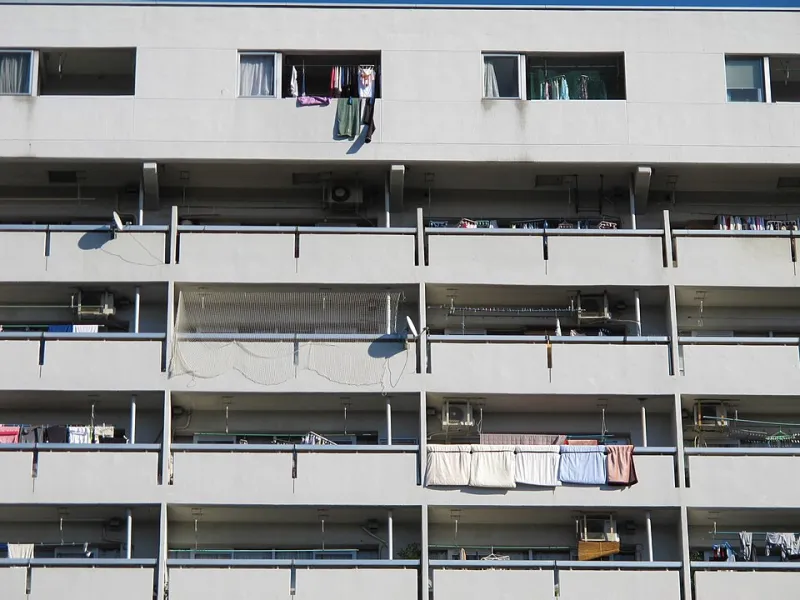
Sukima is a crevice, a gap, an opening. It can mean a crack in a fence or a slot between buildings. In a dense Japanese town, a narrow gap between an apartment block and a low wall is not always a mistake. Sometimes a potted plant sits there, catching rain from the roof. Sometimes a cat uses it. Sometimes it is simply a vent for the block.
In American homes, we tend to seal gaps. We caulk, insulate, and fill. Sukima suggests that not every gap is a problem. A small opening can be circulation. A little unused space between furniture can keep a room from feeling staged.
4. Kabe Giwa: The Wall's Edge
Kabe giwa literally means the wall's edge. It is the strip along the base of a wall, the place where the room meets its boundary. In a station corridor, this is where the umbrellas lean. In a classroom, it is where the extra chairs wait. The center of the room is for activity. The edge is for what is set down.
This is the quiet territory the blog is named for. The kabe giwa is not the main event. It is the place where daily life accumulates in small, unplanned ways: shoes, bags, a broom, a child's drawing taped low to the wall. If you clear the center of a room but leave the edge alone, the edge will tell you what the room is actually used for.
5. Tokonoma: The Alcove With Room to Spare
A tokonoma is a display alcove in a traditional tatami room. It usually holds very little: a hanging scroll, a vase, perhaps a single seasonal branch. The rest is empty. The empty space is part of the composition. It gives the one object room to be seen.
You do not need a tatami room to use this idea. A shelf with one object and a deliberate expanse of bare wood can do the same work. The point is not minimalism as a style. The point is that an object can become more visible when it is not surrounded by other objects.
6. Engawa: The Veranda Between Inside and Out
An engawa is the wooden veranda that runs along the edge of a traditional house. It is not fully inside and not fully outside. In the rain, a pair of slippers waits there, just under the roof. The engawa is a threshold, a place to sit and look at the garden without entering it.
In a US home, the equivalent might be a windowsill, a stoop, or a small balcony. These are not rooms. They are edges. They are useful precisely because they are not fully programmed. A chair on a stoop can be enough.
7. Niwa: The Garden That Leaves Things Out
Niwa means garden, but a small Japanese courtyard garden can be mostly gravel, moss, and a few stones. It may have no flowers at all. The absence is not a lack of care. It is a way of making the garden quiet enough to notice the weather.
In an American yard, niwa might mean leaving part of the lawn unplanted. Not every corner needs a shrub. A patch of bare ground can be a place where rain collects, where the light changes, where you simply stand.
The Edge Is Not Wasted
The point is not to Japanify your apartment or turn your life into a meditation app. The point is to notice that empty space can be intentional. In 2026, with delivery boxes stacked by the door and notifications filling every pause, the edge is a quiet form of resistance. Leave a gap on the shelf. Leave ten minutes unscheduled. Let a conversation pause without rushing to fill it. The wall's edge is not wasted space. It is where the room waits.