Small Gods by the Curb: A Field Guide to Japan's Roadside Shrines
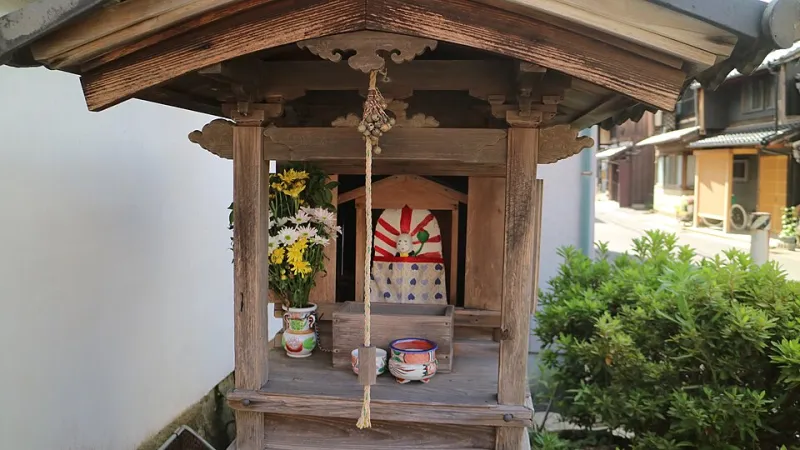
Photo: NevinThompson, CC BY-SA 4.0, via Wikimedia Commons
The first one I noticed was not a temple. It was a roof no bigger than a mailbox, wedged between a coin parking lot and a hair salon. Under the roof stood a fox statue with a chipped ear and a plastic bottle of tea. There was no sign, no gate, no one around. A small wooden shelf held a spent match and a folded paper wrapper. The shrine was not asking to be visited. It was simply there, at the edge of the block.
In Japanese towns, these small sacred places are common enough to become part of the street furniture of memory. They are not usually tourist sites. They are not always officially registered. They are tended, or half-tended, by someone who lives or works nearby. To notice them is to notice a different kind of urban care.
The Geography of the Gap
These shrines tend to appear where land has been left over. The strip between a building and a retaining wall. The corner of a parking lot where a car cannot fit. The end of an alley that leads nowhere. A concrete ledge above a drainage channel. In a dense town, the edge is often the only place left.
Some of these shrines predate the buildings around them. A stone marker may have stood at the edge of a village long before the village became a neighborhood of coin parking and apartment blocks. The parking lot was built around it, or beside it, because moving it would be awkward, expensive, or disrespectful. Other shrines were placed there later, in a gap that felt like it needed something.
What Counts as a Shrine
Not every roadside sacred place is a full shrine. Some are small hokora, miniature buildings with a tiny door. Some are stone markers with faded characters. Some are Jizo statues, often wearing red bibs and knit caps. Some are Inari altars with fox guardians. Some are simply a pile of stones at the base of a wall, or a wooden shelf holding a cup of water.
The common thread is not architectural style. It is attention. Someone has decided that this spot is not empty. A bottle of water is replaced. A sprig of nandina is set in a vase. A small broom leans against the wall. The shrine may be humble, but it is not abandoned.
Who Keeps Them
Often, no one knows. The caretaker might be the owner of the nearby shop, an elderly neighbor, or the manager of the building whose wall the shrine leans against. They do not usually perform ceremonies. They sweep. They replace the water. They leave a seasonal flower. Sometimes they salt the ground. The care is small and intermittent, which is part of what keeps it going.
In one town, I watched a woman in a cardigan arrange two stems of nandina in a cracked vase. She did not bow. She did not clap. She looked at the shrine for a moment, adjusted the vase, and walked back to her shop. The whole act took less than a minute. It was not a performance of faith. It was maintenance.
How They Survive
Urban change is not kind to small things. Roads widen. Houses are torn down. Parking lots multiply. A shrine survives because it is inconvenient to remove, because someone objects, or because the new construction simply builds around it. Sometimes a shrine is incorporated into a new building, set into a recess in the wall like a tiny stage. Sometimes it disappears, moved to a temple or quietly lost.
The edge is both protected and precarious. It is overlooked enough to remain, but overlooked enough to vanish. That tension is part of what makes these places worth noticing. They are not monuments. They are practices that happen to have a roof.
Why the Edge Matters
A shrine at the edge of a block says something about local care. It is not central. It is not monumental. It does not require a plaza or a visitor center. It is simply attended. Sacredness can be small enough to fit between two parking spaces. It can be a stone no taller than a knee.
For US readers, the comparison is not exact, but it is nearby. Think of roadside memorials, old church steps, a statue in a strip-mall planter, or a grotto behind a hardware store. These are places where private memory and public space overlap. They are easy to miss because they are not designed for attention. They are designed for maintenance.
A Quiet Way to Look
The next time you walk through a Japanese town, slow down at the edges. Look at the base of walls. Look between buildings. Look for small roofs, red bibs, faded stone, fresh water, a single flower in a plastic bottle. If someone is tending a shrine, nod and keep moving. Do not treat it as an attraction. The point is not to collect shrines. The point is to notice care.
The tiny shrine between the parking lots is not a relic. It is a practice. Someone fills the water. Someone sweeps. The city changes around it. In 2026, that is a quiet kind of memory, and it is still happening at the edge of the block.