The Umbrella You Didn't Buy: A Japanese Shop Custom That Trusts the Rain
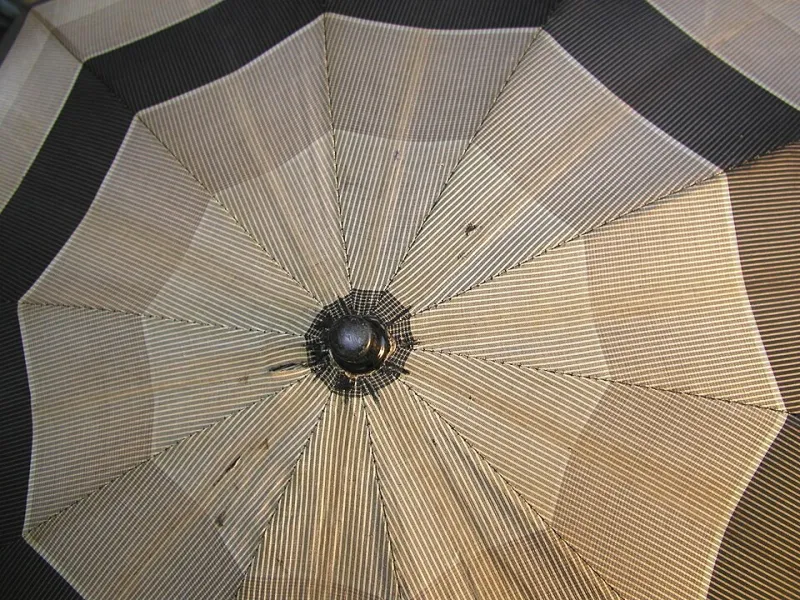
Photo: Windsor, CC BY 4.0, via Wikimedia Commons
Last week I stepped out of a tiny shop in my neighborhood with a paper bag of groceries and no umbrella. The rain was not dramatic, just steady enough to soak a jacket in two blocks. Then I saw the rack by the door: six clear plastic umbrellas, handles up, waiting. A handwritten sign taped to the wall said, more or less, 'Please use one and bring it back when you can.' No deposit. No clerk watching. No app. Just a rack of umbrellas and a sentence that assumed I might be decent.
A Rack by the Door
The umbrellas are the cheap kind, clear plastic, white handle, a little flimsy at the ribs. They are the same umbrellas you can buy at a convenience store for a few hundred yen, the ones that turn inside out in a strong gust. But outside this shop they have a different status. They are not merchandise. They are a small public service, offered at the scale of one doorway. The rack itself is simple: a metal frame, a little rust at the joints, a sign zip-tied to the top. In the US, the umbrella by the door is usually yours, or it belongs to the coffee shop and comes with a deposit and a stern look. Here, the transaction is almost entirely social.
The Sign That Asks Gently
I have seen variations of the sign. Some say 'Please borrow freely.' Some say 'Return when you can.' One near the station had a cartoon of a cloud and a smiling umbrella. The tone is not legalistic. It does not threaten consequences. It does not ask for your name or your phone number. It asks you to remember. That is the whole mechanism: memory plus mild guilt plus the next rainy day. The custom works because most people do bring the umbrella back, eventually. Not all of them. But enough.
Low-Stakes Trust
What I find interesting is how low the stakes are. A clear plastic umbrella is not a valuable object. If you keep it, the shop loses a few dollars at most. But the custom is not really about the umbrella. It is about practicing a small kind of trust in public. The shop owner is saying, in effect, 'I assume you are not here to steal from me.' The borrower is saying, 'I will try to be the kind of person you assumed I was.' That is a tiny contract, and it lasts only as long as the rain. There is something refreshing about a generosity that does not require a receipt.
Where the Custom Stops
The custom has limits. It works best in neighborhoods where people walk, where shops know their regulars, and where the rain is frequent enough that everyone has been caught without an umbrella at least once. It would be harder to run in a big-box store or a train station, where the crowd is anonymous and the umbrellas would disappear by noon. Some shops do keep a loaner umbrella chained to the rack, or they ask for a small deposit. The custom is not naive. It is calibrated. It knows that trust needs a little structure, even if that structure is just a handwritten sign and a rack by the door.
What Stays With You
I brought the umbrella back the next morning. The shop was not open yet, so I leaned it against the rack and went on my way. It felt like returning a library book to a shelf that had no due date. I do not know if the owner saw me. I do not need them to. The small pleasure was in completing the loop. In a city of millions, a clear plastic umbrella is a strange thing to remember. But I do remember it. And now, when I see a rack outside a shop, I check the sky a little differently.