What the Concrete Keeps: Reading a Japanese Corner by Its Retaining Wall
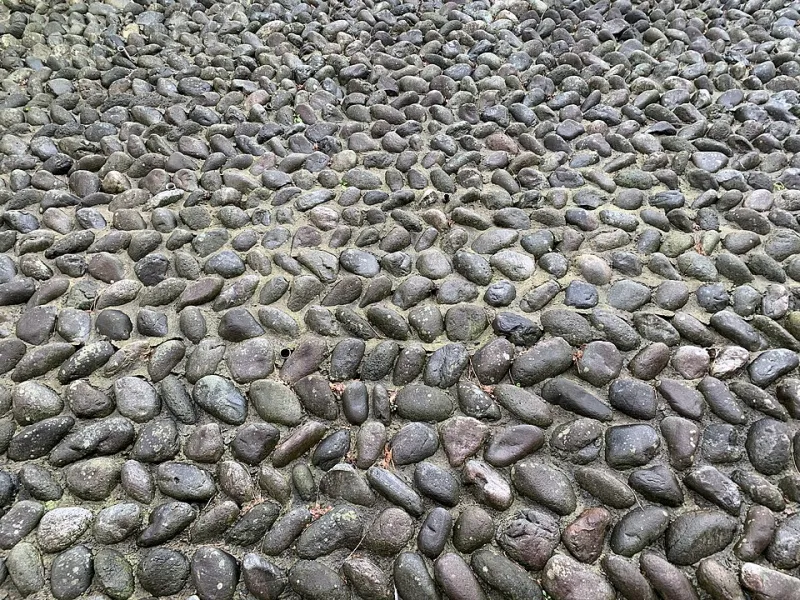
Photo: Tbatb, CC BY-SA 4.0, via Wikimedia Commons
On my walk to the station, there is a corner where the street bends around a concrete retaining wall. It is not beautiful. The concrete is stained, the top edge is furred with weeds, and a drainage channel runs along its base like a seam. I have passed it hundreds of times without looking. Then one morning this November, a handwritten notice taped to a block fence caught my eye: a small warning about slippery pavement, the characters slightly smudged by rain. That was the moment the corner became a thing to read rather than a thing to pass.
The Corner That Does Three Jobs
A retaining wall is usually described by what it holds back. Here, it holds back a low bank of soil and a few garden trees. But at this corner it also does two other jobs. It carries a drainage channel that moves rainwater away from the intersection, and it forms the back wall of a narrow parking area for bicycles. The wall is infrastructure, fence, and boundary all at once. In the US, we tend to notice retaining walls when they fail, when a slope slips after a storm or a strip-mall parking lot starts to crack. In Japan, especially in older residential neighborhoods, the wall is part of the everyday furniture of the street. You lean against it while waiting for a light. You use it to judge how far the sidewalk has narrowed. You never thank it.
Moss in the Seams
The seams are where the wall tells time. Between the concrete blocks, moss has settled in dark green lines. Some seams are tight and dry; others have begun to hold a little soil, enough for a dandelion or a tuft of grass. The moss is not a sign of neglect, exactly. It is a sign that the wall has been there long enough for weather to make a home in it. The drainage channel at the base is likewise ordinary and precise: a shallow concrete trough with a metal grate over one section, a few leaves caught at the edge. When it rains, the water has somewhere to go. That is the quiet promise of the corner. Not that nothing will happen, but that the water will be led away.
The Notice Taped to the Block
The handwritten notice was small, the kind of thing you might miss if you were checking your phone. It said something like 'Please be careful; the surface is slippery after rain.' No official logo, no laminated sheet, no QR code. Just a neighbor or a shop owner with a piece of paper and a roll of tape. I liked that the notice did not try to solve the problem. It only asked for attention. There is a particular kind of care in that. It assumes you are a person who can adjust your step, not a customer who needs a warning label. The tape had begun to peel at one corner, and someone had pressed it back down. Maybe the same person. Maybe a stranger.
What Maintenance Looks Like
The wall is maintained in small increments. A crack gets sealed. A block gets replaced. The weeds on top are cut back before they get too tall. None of this is dramatic, and most of it happens without a ceremony. I once saw a man in a blue work jacket sweeping the drainage channel with a hand broom. He was not cleaning the whole street, just the part where the water collects. It took maybe two minutes. Then he was gone. That is the scale of maintenance here: not a project, but a habit. The wall stays put because people keep noticing it.
The Wall on Your Own Route
Since I started paying attention to this corner, I have begun to notice the retaining walls on my other routes. The one behind the laundromat with a chain-link fence on top. The low block wall near the elementary school where someone has planted geraniums in a row of pots. The concrete slope by the bus stop that has been patched so many times it looks like a map. These edges are not scenic. They are the quiet arithmetic of a neighborhood: soil plus water plus gravity, held in place by concrete and attention. On your own daily route, there is probably a wall like this. Maybe it is the one you lean on while you wait for the dog to finish sniffing. Maybe it is the one you never see. Either way, it is doing work. And someone, somewhere, is keeping an eye on it.